
Jeremy Wade is a British television presenter, angling author and biologist best known for River Monsters. What makes him relevant here is not celebrity value, but method. He approached fishing as investigation: collecting local stories, studying habitats, understanding species behaviour and building a plan around evidence rather than hype. That is exactly what premium guided fishing should feel like. You are not selling luck. You are building the best possible chance through preparation, interpretation and judgement.
Who is Jeremy Wade, and why does he matter?
According to the Wikipedia article, Jeremy John Wade was born in 1956 in England, studied zoology and also worked as a teacher before moving fully into fishing, writing and television. River Monsters, Mighty Rivers and Dark Waters became strong because Wade never chased spectacle alone. He asked questions first: what species could be responsible, what habitat are we looking at, what is local knowledge, and what is legend versus testable reality?
River Monsters was really about investigation
Many viewers remember the suspense, but the deeper value of the series was structure. Each episode started with a problem: missing people, strange attacks, unexplained local accounts or iconic fish. Wade then moved through interviews, fieldwork, habitat reading and species analysis. For a guide business, the lesson is simple: the quality of a trip is built long before the first cast.
Why his mindset is credible for guiding
Wade’s credibility comes from the logic behind the visuals. He did not rely on a single lure or trick. He interpreted depth, current, season, water temperature, food sources, local experience and natural fish behaviour together. That is how a serious guide creates value: not only telling the guest where to cast, but also explaining why that decision makes sense at that moment.
Practical takeaway
A premium trip becomes valuable when local expertise, preparation, equipment and communication reinforce one another.
India, the Amazon and the Congo: lessons from major expeditions
Jeremy Wade’s work became international very early. From India’s mountain rivers to the Congo and the Amazon, his travels showed that unfamiliar water rewards preparation, local contacts and risk awareness. For clients, this is highly relevant. Good logistics, the right tackle, the right boat and trusted local partners can matter more than the final catch photo.
The goonch catfish and the power of method
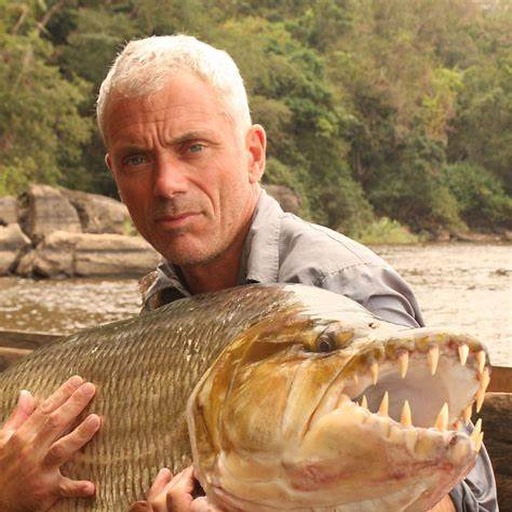
One of the most famous River Monsters investigations focused on the goonch catfish in India. The real lesson is not only the size of the fish, but the process behind the capture: listening to local reports, reading the environment, narrowing down likely species and then preparing specifically for the mission. This is the same logic that makes premium guided trips effective.
Risk management, not recklessness
Jeremy Wade’s stories often involve remote places, heavy current, dangerous species and unpredictable environments. Yet the value is not recklessness. It is controlled risk. Premium guiding works the same way. Guests do not only want excitement; they want the reassurance that the skipper or guide has control over timing, tackle, communication and the backup plan.
What Fish Guide Net can learn from this
For our project, the Jeremy Wade lesson means that recommendations must not be generic. Different clients need different waters, guides, timing and expectation management. A credible recommendation combines target species, season, budget, comfort level, logistics and realistic catch potential. When this is communicated well, the guest feels they received professional advice, not just a catalogue listing.
Conclusion
Jeremy Wade’s legacy is not just media value. The deeper takeaway is that successful angling depends on curiosity, field discipline, habitat understanding and better decisions. That is exactly the quality a premium guided-fishing business should deliver. The catch is the visible result; the real product is the thinking and organization behind it.